Every park that adds a train eventually faces the same choice: lay track, or buy a vehicle that steers itself. The decision changes the installation cost, the route and the way the ride is operated for the next decade. This guide explains when a trackless amusement park train is the better investment.
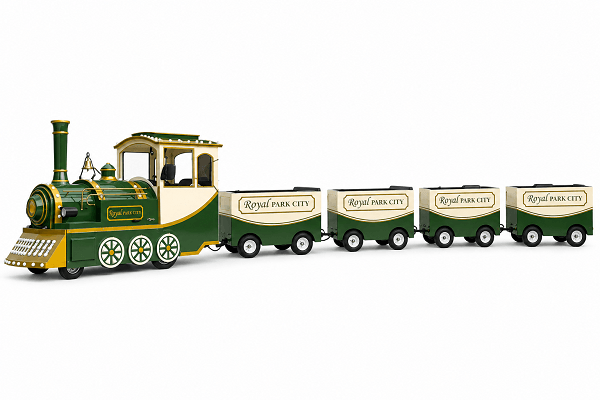
Start With the Route You Need
Trackless trains follow the paving rather than a fixed rail, so the route can be changed, shortened or extended as the park develops. That flexibility is valuable in a site with seasonal zones, temporary events or planned expansion. A rail-based ride is cheaper to operate on a long, fixed circuit, but it cannot respond when the park decides to move a stop or open a new area.
Compare Installation and Ground Work
Laying track requires excavation, foundations, drainage and a construction programme that can close paths for weeks. A trackless train needs a suitable driving surface and a turning area, which is often much faster to provide. For a park with limited construction windows or a rented site, that difference can decide the project before the vehicle specification is discussed.
Match the Vehicle to the Terrain
Trackless trains work well on gentle gradients and paved routes, while steep climbs and rough ground favour a rail system. Ask for the maximum gradient, the turning radius and the surface requirements, then compare them with the actual site. A buying guide for an amusement park train buying guide should include those figures, because a route that looks flat on a map often hides a slope that changes the specification.
Consider Capacity and Carriages
Both systems can pull several carriages, but the trackless vehicle’s towing capacity and braking performance depend on the surface and the gradient. Confirm the rated capacity at the planned load rather than at an average, and check how the train behaves when one carriage is full and another is empty. Capacity per hour, not seats per train, is the figure that matters.
Plan the Operating Routine
A trackless train needs a driver and a defined route, while a rail system constrains the driver to the track but may require more elaborate signalling. Staffing, maintenance access and emergency procedures should be compared for both options. Reviewing the Dinis trackless train ride range shows how different models are arranged for park routes, and the operating principles are described in reference material on trackless train operation.
Weigh the Long-Term Flexibility
Finally, think about how the park will change. A trackless train can follow a new path when a zone is rebuilt, while a rail ride is tied to its track. If the site plan is still evolving, that flexibility is worth paying for; if the route is fixed for a generation, rail may deliver lower operating costs. The right answer depends on the plan, not on a general preference for one technology.
A trackless amusement park train wins when the route must stay flexible, the ground work is limited and the site is still developing. Compare the route, installation, terrain, capacity, operating routine and long-term flexibility before choosing. Operators can review the range from Dinis amusement park train supplier and start from the product page at https://www.dinistrains.com/amusement-park-train-for-sale/.
Leave a Reply