Successful digital play does not replace movement. It gives movement a clearer purpose through responsive visuals, sound, scoring, and competition. A sensor-based digital entertainment equipment package can turn jumping, throwing, running, aiming, or teamwork into an experience that reacts instantly to the guest. For amusement manufacturers, FEC operators, park investors, and equipment buyers, the central challenge is integration: the technology, physical activity, spatial design, and operating model all need to function as one attraction.
Why Does Physical-Digital Play Appeal to Modern FEC Audiences?
Physical play supplies energy, social interaction, and a sense of achievement. Digital layers provide goals, feedback, changing content, and visible results. Together, they can engage children, teenagers, young adults, families, and corporate groups without making the experience dependent on a headset or a passive screen.
The combination can also improve replay value. A fixed climbing, throwing, or jumping action becomes more varied when the software changes targets, timing, difficulty, teams, or scores. Guests can try again to improve a result, challenge friends, or explore another mode. This creates a stronger reason for repeat sessions, but only when the interaction is clear and reliable.
Which Activities Work Best with Digital Interaction?
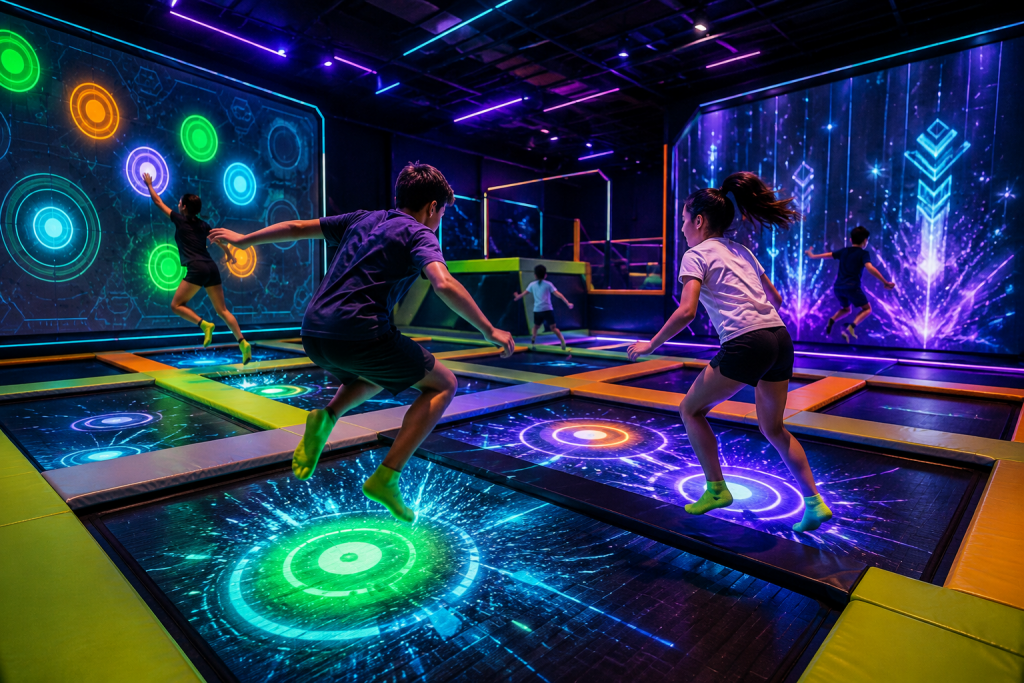
The strongest applications begin with an intuitive physical action. Interactive floors can respond to steps and movement. Projection walls can support ball games, reaction challenges, or cooperative missions. Sensor targets can measure accuracy and speed. Digital sports can adapt familiar activities such as football, tennis, golf, bowling, darts, or archery. Lighting grids and immersive shooting formats can add group competition.
Buyers considering a custom interactive play system for FECs need to match each activity to the target age, expected group size, session length, staff model, and available footprint. More technology is not automatically better. The best system makes the guest’s next action obvious.
How Can Layout Connect Technology with Safe Movement?
Design teams need to map approach routes, active zones, spectator positions, equipment clearance, projector or sensor locations, staff sight lines, and exit paths. Lighting conditions matter because glare or uncontrolled daylight can reduce projection visibility. Sound needs to energize the attraction without overwhelming nearby areas. Network, power, ventilation, and equipment-access points also require early coordination.
Themed integration can make separate modules feel like one destination. A Future World indoor park concept illustrates how interactive projection, AR games, futuristic lighting, trampolines, role-play areas, and adventure elements can share a consistent visual story. The same principle applies at a smaller scale: graphics, interfaces, signs, and physical finishes can reinforce one operating concept.
What Technology Choices Support Reliable Daily Operation?
Operators can evaluate sensor accuracy, response time, calibration needs, content management, software updates, restart procedures, spare parts, remote support, and offline functionality. A useful system is not only impressive during a demonstration. It also recovers quickly from interruptions and gives staff a clear way to identify problems.
The broader concept of interactive media principles is relevant because the guest’s action and the system’s response form a continuous loop. If feedback is delayed, unclear, or inconsistent, participation drops. Procurement tests therefore need to include real movement, multiple players, peak lighting conditions, and realistic operating sessions.
How Can Operators Measure Commercial Performance?
Operators can track participation, throughput, replay rate, session completion, downtime, maintenance hours, event bookings, customer feedback, and secondary spending. Digital leaderboards may support competitions and social sharing, while modular content can enable seasonal campaigns without rebuilding the physical attraction.
The investment case needs to include hardware, software, installation, content licensing, networking, staff training, maintenance, and future updates. The Miland commercial play project specialists can help align the equipment mix with venue size, target audience, theme, and project goals. A complete evaluation compares lifecycle value, not only initial purchase price.
What Makes a Physical-Digital Attraction Successful Long Term?
Long-term success comes from balance. The physical activity needs to remain enjoyable, the digital response needs to be immediate, the rules need to be easy to understand, and the system needs to be manageable for staff. Content needs enough variety to support repeat visits without creating operational complexity.
In conclusion, merging physical play with digital entertainment works when design, technology, operations, and customer needs are planned together. Investors and buyers can begin with a clear audience and activity, then select responsive equipment, integrate it into the venue, test it under realistic conditions, and measure its contribution after opening. That approach turns digital features into durable commercial attractions rather than short-lived visual effects.
Leave a Reply