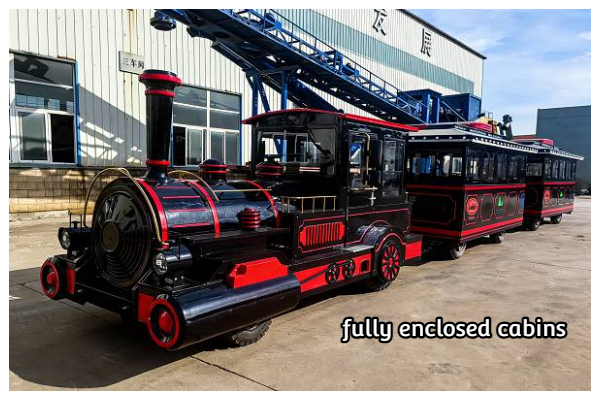
Zoos, resorts and scenic areas usually come to the same question late in the planning process: should the trackless train run on diesel or on batteries? The answer depends far more on the route and the operating day than on the price list, and the wrong choice shows up as lost running time exactly when visitor numbers are highest. This guide explains when a site should select diesel power for a trackless train.
Compare Diesel and Electric Power Honestly
Electric trains suit short, flat circuits with a fixed depot and predictable daily distances. Diesel trains suit long routes, steep sections, heavy carriage sets and sites where recharging infrastructure would be difficult or expensive to install. Neither option is universally better, so the comparison should be made against the actual route profile, the number of daily circuits and the availability of electrical capacity at the depot, rather than against a general preference for one technology.
Distance, Gradient and Daily Cycles
Two sites can have the same route length and completely different demands, because gradients and stop frequency change energy use dramatically. A zoo circuit that climbs a hill eight times a day asks much more of the drivetrain than a flat resort loop of identical length. Operators considering choosing a diesel trackless train should record the steepest section, the number of stops, the loaded weight and the total daily distance, then ask the manufacturer for a consumption estimate based on those figures.
Refuelling and Fuel Storage on Site
Diesel brings its own infrastructure requirements, and they are usually simpler than installing a high-capacity charging system across a large site. A single bunded tank near the maintenance yard with a documented refuelling procedure can serve several trains, and a top-up during a scheduled break takes minutes rather than hours. The tank position should still be planned with guest safety and local fuel storage rules in mind, and the connection point needs level ground and adequate lighting.
Noise, Emissions and Guest Comfort
Diesel trains are louder than electric ones, so the route matters. A train running along a service road or through a working area is rarely a problem, while one passing close to animal enclosures, outdoor dining or performance venues needs a quieter vehicle or a different route. Modern engines with effective exhaust treatment and enclosed cabins reduce the impact considerably, and the final decision should be based on noise and exhaust measurements taken on site rather than on general assumptions about diesel vehicles.
Where Diesel Wins: Long, Remote and Heavy Routes
Diesel becomes the practical answer when the route is long, when the terrain rises sharply, when the train pulls several carriages all day, or when the site has no realistic way to deliver enough electricity to the depot. Resorts that run continuous circuits and scenic attractions that cover several kilometres are typical examples. Reviewing the vintage amusement park train models range shows how carriage configuration changes the load the engine has to move, which is often the deciding factor.
Maintenance, Spares and Operating Cost
Operating cost should be assessed over several seasons, including fuel, routine servicing, oil and filter changes, brake and tyre wear and the downtime of each service interval. Diesel engines are familiar to most workshop teams and use widely available parts, which keeps unplanned stops short. The engineering background behind these systems is well described in reference material on diesel powered train traction, and that knowledge helps buyers ask sensible questions about service intervals and consumables before signing the order.
The choice between diesel and electric comes down to the route and the operating day. Compare both technologies honestly, measure the gradients and daily cycles, plan refuelling and storage, check noise and emissions along the actual route, and weigh the long-term maintenance burden. Where the route is long, heavy or remote, diesel usually delivers the most reliable service across a full season. Operators can review the range from Dinis trackless train rides supplier and start at https://www.dinistrains.com/diesel-trackless-train-for-sale/.
Leave a Reply